Reviewed by Sahil Chopra, MD.
Research by Savit Malhotra
Introduction
After a hot summer day, we often expect some relief once the sun goes down. But in many cities, that relief does not come as quickly as it does in surrounding rural areas. Roads, sidewalks, parking lots, rooftops, and buildings absorb heat throughout the day and release it slowly after sunset, contributing to a phenomenon known as the urban heat island effect.[1,2] In the United States, urban areas can be approximately 1-7°F warmer during the day and 2-5°F warmer at night than nearby outlying areas.[1] That nighttime difference may be particularly important for sleep. A growing body of research shows that elevated nighttime and bedroom temperatures are associated with shorter sleep, greater wakefulness, and poorer sleep quality.[3,4,5,6,7] As cities grow and extreme heat becomes more common, the temperature outside the bedroom may increasingly influence what happens inside it.
What Is an Urban Heat Island?
An urban heat island occurs when a developed area becomes warmer than its less-developed surroundings. Natural landscapes contain trees, soil, and vegetation that provide shade and help cool the air through evapotranspiration, the movement of water from the ground and plants into the atmosphere. Urban development often replaces these surfaces with asphalt, concrete, roofs, and other materials that readily absorb solar energy.[1,2] During the day, these surfaces store heat. Once the sun goes down, that stored energy is gradually released back into the surrounding environment.
Cities can also have less airflow between densely packed buildings, fewer trees to provide cooling and shade, and additional heat produced by vehicles, buildings, air-conditioning systems, and other human activity.[1,2] The result is not simply a hotter afternoon. One of the defining features of many urban heat islands is that cities can remain warmer well into the night, precisely when the body is trying to prepare for sleep.[1]
Urban heat islands and heat waves are related, but they are not the same thing. A heat wave is a period of unusually hot weather affecting a region, while an urban heat island is a persistent difference between a developed area and its surroundings. When a heat wave occurs over a city, the two effects can overlap: unusually high regional temperatures are layered on top of a built environment that already retains heat.[1,2]
Why Does Temperature Matter for Sleep?
Sleep and body temperature are closely connected. In the hours around sleep onset, the body begins redistributing heat from the core toward the skin, particularly the hands and feet. This heat loss accompanies the normal decline in core body temperature that occurs during the biological night and is closely related to the transition from wakefulness into sleep.[3,4]
A hot environment can make that process more difficult. When the surrounding air is already warm, especially when humidity is also high, the body has fewer effective ways to release excess heat. Research examining thermal environments during sleep has found that excessive heat can increase wakefulness and alter sleep architecture, including reductions in slow-wave and REM sleep under some experimental conditions.[4,5] Unlike being slightly chilly, which can often be compensated for with bedding, excessive warmth can be difficult to escape once someone is already under the covers.[4]
This is one reason nighttime temperature matters separately from daytime temperature. A very hot afternoon may be uncomfortable, but if the environment cools substantially after sunset, the body has an opportunity to recover. When buildings and pavement continue radiating stored heat late into the night, bedrooms, particularly those without effective cooling, may remain warm throughout the sleep period.
What Does the Research Show?
The overall evidence linking heat and poorer sleep has become increasingly consistent. A 2024 systematic review in Sleep Medicine Reviews examined real-world research on ambient temperature and sleep and concluded that higher indoor and outdoor temperatures are generally associated with worse sleep quality and quantity. The effects appeared across several different sleep measures and tended to be greater during particularly hot periods, in warmer regions, and among vulnerable populations.[6] The authors also found limited evidence that people rapidly adapt their sleep to increasingly hot conditions.[6]
One of the largest studies to date examined more than 7 million nights of sleep from 47,628 people across 68 countries using sleep-tracking wristbands.[7] Warmer nighttime temperatures were associated with shorter sleep, largely because people fell asleep later. On very warm nights when minimum temperatures exceeded 30°C (86°F), participants slept approximately 14 minutes less than on nights associated with the least temperature-related sleep loss. The effects were greater among older adults, women, people living in lower-income countries, and residents of already-hot regions.[7]
Earlier research reached a similar conclusion using a very different method. A 2017 study combined nighttime temperature records with survey responses from approximately 765,000 adults in the United States. Higher nighttime temperatures were associated with more self-reported nights of insufficient sleep, with particularly pronounced effects during the summer and among older and lower-income adults.[8] Because these studies use different populations and ways of measuring sleep, their convergence strengthens the evidence that nighttime heat itself is an important environmental factor for sleep.
What Happens When the Bedroom Itself Gets Hot?
Outdoor temperature is only part of the story. Ultimately, what matters to a sleeper is the thermal environment inside the bedroom, and indoor temperatures can sometimes remain high even as outdoor temperatures begin to fall. In a longitudinal study of community-dwelling older adults, researchers continuously measured bedroom temperatures alongside sleep using wearable devices. Sleep was most efficient and restful when bedroom temperatures were approximately 20-25°C (68-77°F). As temperature increased from 25°C to 30°C (77°F to 86°F), sleep efficiency declined by approximately 5-10%.[9] Importantly, there was substantial variation between individuals, meaning there is no single perfect bedroom temperature for everyone. Controlled laboratory research supports these observations. In one experiment, adults over age 65 slept in rooms at either 27°C or 30°C. At 30°C, participants slept about 26 minutes less, spent approximately 27 additional minutes awake, and had lower sleep efficiency and less REM sleep than at 27°C.[10] Improved ventilation provided some benefit, demonstrating that both temperature and the overall bedroom environment matter.[10]
Real-world research also shows just how different indoor and outdoor conditions can become. A 2025 study conducted in one of the hottest marginalized communities in Los Angeles monitored bedroom temperature and sleep across 409 nights. Indoor apparent temperatures ranged from 26°C to 35°C and averaged approximately 5°C higher than outdoor conditions. A 5°C increase in nighttime bedroom temperature was associated with approximately 23 fewer minutes of sleep.[11] The study was small, with 19 participants, so the exact effect should not be generalized to everyone, but it illustrates an important point: checking the outdoor forecast may not tell you how hot the room you are sleeping in actually is.
Why Urban Heat Can Become a Sleep Inequality Issue
Not everyone experiences nighttime heat equally. Neighborhoods can vary dramatically in tree coverage, pavement, building density, housing quality, access to air conditioning, and proximity to large heat-absorbing surfaces. These differences can create temperature variations within the same city. A study of 20 metropolitan regions in the southwestern United States found substantial disparities in summertime heat exposure. On average, neighborhoods in the lowest income decile were approximately 2.2°C (4°F) hotter during daytime and extreme-heat conditions than the wealthiest neighborhoods. In some California metropolitan areas, including the Inland Empire and Palm Springs, the disparity reached approximately 3.3-3.7°C (6-7°F).[12] Nighttime disparities were smaller, but the study demonstrates how unevenly urban heat can be distributed.[12]
Housing conditions can further amplify those differences. Research in children found that those from lower-income households were more likely to experience bedroom temperatures at more extreme ends of the measured range, while both overly hot and overly cold bedrooms were associated with poorer sleep.[13] More recent U.S. wearable data from the All of Us Research Program also found that heat-related sleep effects were not evenly distributed: older adults, women, people with lower socioeconomic status, and individuals with certain chronic health conditions showed greater vulnerability.[14] This means urban heat is not just a question of whether a city is hot. Where someone lives, the design of their neighborhood, the construction of their home, and whether they have access to effective cooling can all affect how much nighttime heat actually reaches them.
Older Adults May Be Especially Vulnerable
Older adults deserve particular attention. Aging can reduce the body's ability to respond efficiently to heat, and older adults are also more likely to take medications or have health conditions that alter thermoregulation.[15] Sleep already tends to become lighter and more fragmented with age, so an excessively warm bedroom can add another challenge. The studies described earlier support this concern. Both real-world monitoring and controlled experiments have demonstrated declines in sleep efficiency among older adults as bedroom temperatures rise.[9,10] A recent review of heatwaves and tropical nights likewise found that elevated nighttime temperatures in middle-aged and older adults were consistently associated with reductions in total sleep time and sleep efficiency and increases in nighttime wakefulness.[16]
Can Green Space Help Cool the Night?
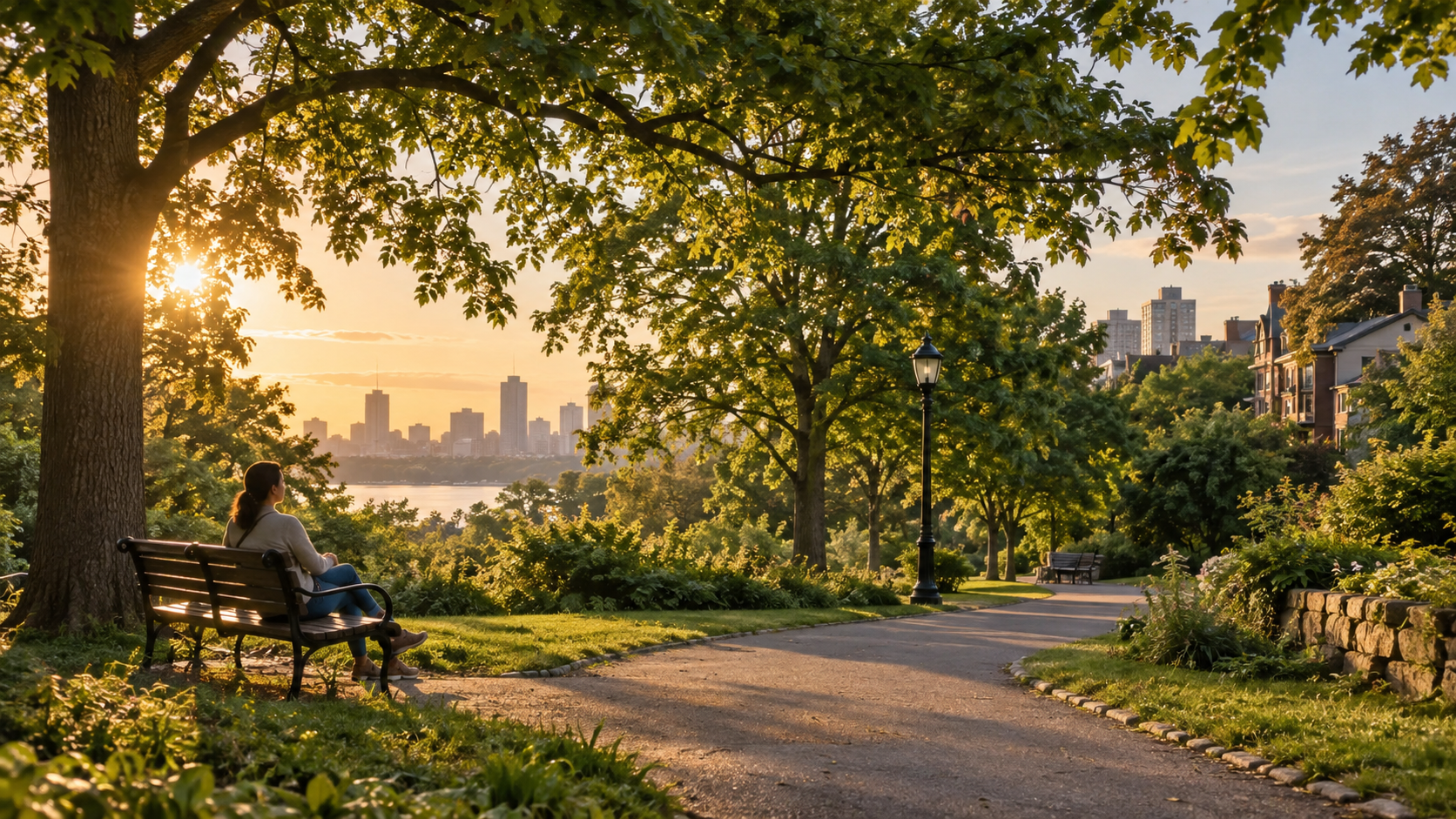
This brings us back to the previous article in this series. Trees and vegetation can help mitigate urban heat by shading surfaces and cooling the surrounding environment through evapotranspiration.[2] Green roofs can provide similar localized benefits, while reflective roofs and some types of cooler pavement reduce the amount of solar energy stored by the built environment.[2,17] There is even emerging research connecting these environmental changes directly with sleep. A 2024 study involving 584 participants examined green space, heat stress, and sleep during both heat events and control periods. Greater nearby vegetation was associated with lower perceived heat stress, and grass and shrub cover showed protective associations with reported sleep quality at several spatial scales.[18] Because the study was observational, it cannot prove that adding vegetation would automatically improve someone's sleep, but it provides another possible pathway connecting green space with nighttime health.
What Can You Do When Hot Nights Are Affecting Your Sleep?
You may not be able to redesign your neighborhood, but reducing the heat reaching your bedroom can still help. The National Heart, Lung, and Blood Institute recommends keeping the bedroom cool, quiet, and dark as part of a sleep-friendly environment.[19] During periods of extreme heat, air conditioning can be particularly important for preventing dangerous heat exposure, especially among vulnerable individuals.[15,20]
When it is cooler outside than inside, ventilation can sometimes help remove accumulated indoor heat. Closing blinds, shades, or curtains during periods of direct sunlight can also reduce solar heat entering a room, while lighter bedding and sleepwear may help reduce unnecessary insulation. The European Insomnia Network recommends keeping the bedroom as close as practical to approximately 20-25°C during heatwaves and notes that a cool or lukewarm, not ice-cold, shower before bed may help with thermal comfort.[16] Importantly, temperature preferences vary considerably between people, so these numbers should be treated as guidance rather than a rigid sleep rule.
Fans can improve air movement and make moderate heat feel more comfortable, but they are not a substitute for cooling during dangerous indoor heat. CDC guidance cautions against relying on a fan when indoor temperatures exceed 90°F (about 32°C) because circulating very hot air may increase body temperature rather than adequately cool it.[20] During extreme heat, people without effective home cooling should consider an air-conditioned location or community cooling center when available.The usual principles of good sleep still matter as well. Going to bed and waking at consistent times, avoiding excessive alcohol near bedtime, limiting late caffeine, and maintaining a dark and quiet environment can prevent heat-related sleep disruption from being compounded by other sleep disruptors.[19]
What Can Cities Do?
Urban heat islands cannot be solved entirely at the bedroom level. Because the built environment helps create the excess heat in the first place, community-level solutions are also important. The U.S. Environmental Protection Agency identifies several major strategies for reducing urban heat: increasing trees and vegetation, installing green roofs, using reflective or “cool” roofs, adopting cooler pavement technologies, and designing communities using heat-conscious planning principles.[2,17] Trees and vegetation provide shade and evapotranspirative cooling, while reflective roofs absorb less solar energy. In buildings without air conditioning, EPA reports that cool roofs can reduce maximum indoor temperatures by approximately 1.2-3.3°C (2.2-5.9°F) under studied conditions.[21]
These interventions matter because heat exposure is not simply an individual behavior problem. If a neighborhood contains little shade, extensive asphalt, poorly insulated housing, and few affordable options for cooling, telling residents to “keep the bedroom cool” only goes so far. Long-term solutions require designing cities and homes that accumulate less heat in the first place.
Conclusion
Cities do not necessarily go to sleep when the sun goes down, and neither does the heat they have accumulated throughout the day. Urban surfaces can continue releasing stored energy for hours after sunset, leaving some neighborhoods and bedrooms considerably warmer than surrounding areas.[1,2] Meanwhile, research ranging from controlled sleep experiments to millions of nights of wearable data consistently indicates that excessive nighttime heat can reduce sleep duration, delay sleep onset, increase wakefulness, and impair overall sleep quality.[6,7,8,9,10,11]
The urban heat island effect therefore adds another layer to the relationship between our environment and our sleep. It also connects many of the topics we have explored throughout this series: climate change can intensify extreme heat, humidity can make cooling more difficult, green space can help moderate local temperatures, and the design of our homes and neighborhoods can determine how much of that heat reaches us at night.
A cooler bedroom cannot solve urban warming, and planting a tree cannot treat a sleep disorder. But understanding how the built environment shapes nighttime temperature can help us think about healthy sleep on a larger scale. Protecting sleep in a warmer world may require not only changing what happens inside the bedroom, but also creating cities that are better able to cool down after dark.


.png)
.png)