Reviewed by Sahil Chopra, MD.
Research by Savit Malhotra and Quynh Theresa Do.
Introduction
Our next featured peptide for this mini-series on peptides and sleep is Selank. Selank has attracted attention as a potential treatment for anxiety and stress-related conditions. Since Selank acts on receptors of the brain similar to well-known anti-anxiety and sleep medications, scientists have explored whether Selank may indirectly affect sleep quality.[1] Although early findings have generated interest, Selank has not been approved by the U.S. Food and Drug Administration (FDA) for the treatment of insomnia, anxiety, or any other condition. Selank is currently under investigation for safety risks. Despite this, it has been, and is still being, sold as a dietary supplement to U.S. consumers.[2] In this article, we review the history of Selank, discuss what researchers currently understand about how it may work, and examine the evidence regarding its potential relationship with sleep.
The History of Selank
Selank was developed in the 1990s by researchers at the Institute for Molecular Genetics of the Russian Academy of Sciences, in collaboration with the V.V. Zakusov Research Institute of Pharmacology.[3] Initially, scientists were interested in creating a compound that could help reduce anxiety without causing many of the side effects associated with traditional anti-anxiety medications, such as excessive sedation, dependence, or impaired cognitive function.[1] Therefore, they designed a peptide based on another peptide called tuftsin. Tuftsin is a naturally occurring chain of four amino acids (Thr-Lys-Pro-Arg). It is found within immunoglobulin G, a type of antibody, and plays a role in immune system regulation.[1,2] Researchers added three additional amino acids (Pro-Gly-Pro) to the tuftsin sequence to create a more stable compound with potential effects on the nervous system. The resulting peptide, Selank (Thr-Lys-Pro-Arg-Pro-Gly-Pro), is a synthetic peptide that consists of seven amino acids.[1]
Early studies suggested that Selank may reduce anxiety-like behaviors in animal models while preserving cognitive performance.[4] Researchers also observed effects on learning, memory, and emotional regulation, leading to further investigation into its potential therapeutic applications.[5] Over the following decades, Selank was studied for a variety of conditions, including generalized anxiety, stress-related disorders, cognitive impairment, and neuroprotection. While some studies reported promising findings, much of the available research has been conducted in animal models or relatively small human trials. Larger, well-controlled clinical studies remained limited, especially those conducted outside of Russia.[2,5]

How Does Selank Work?
Although Selank has been studied for more than two decades, the full mechanisms behind how Selank produces its biological effects are not fully known. Research has shown that Selank acts as a positive allosteric modulator of gamma-aminobutyric acid (GABA) receptors, meaning it can enhance the activity of GABA, the brain's primary inhibitory neurotransmitter, which helps reduce excessive neural activity.[4] Reducing excessive neuronal activity promotes relaxation and therefore regulates sleep.[6] Many medications used for anxiety and insomnia, including benzodiazepines, also work by enhancing GABA signaling. In fact, clinical studies have shown that Selank's physiological effects are similar to those of classical benzodiazepines such as diazepam.[2] Similar to these medications, Selank works as a positive allosteric modulator of GABAA receptors, meaning that it enhances the effects of naturally released GABA without directly activating the receptor itself.[4] Unlike classical benzodiazepines, however, some studies suggest that Selank produces anxiolytic (anxiety-reducing) effects without many of the cognitive impairment, muscle relaxation, or dependence-related effects.[7,8] However, this should be taken cautiously. Other studies have suggested that Selank is categorized among “sedative-hypnotic agents” and that, since there has been limited research on the peptide, more studies are needed to fully determine Selank’s abuse potential.[5]
Beyond GABA signaling, researchers believe that Selank likely acts through multiple biological pathways rather than a single receptor. In addition to altering genes related to serotonin and dopamine signaling, laboratory studies have found that Selank influences the expression of numerous genes involved in neuronal communication, immune function, and cellular signaling.[1,5] Some researchers have also proposed that Selank may affect the release of brain-derived neurotrophic factor (BDNF), a protein involved in learning, memory, and synaptic plasticity.[9] However, these findings remain preliminary, and translating these findings to sleep requires further research. Animal studies have also found that Selank administration alters the expression of genes related to serotonin and dopamine receptors in the brain, though the significance of these changes is not yet fully understood.[5] One leading idea is that, since serotonin helps regulate mood, emotional processing, and the sleep-wake cycle (whereas dopamine influences motivation, reward, and arousal), Selank’s effects on anxiety and emotional regulation may result from coordinated changes across multiple neurotransmitter systems rather than GABA alone.[5]
What Does the Research Say About Selank for Sleep?
Even though there is growing interest in Selank, relatively few studies have directly evaluated its effects on sleep. As mentioned previously, although Selank has been studied for several decades, much of the research has been conducted in animal models or small human studies.[2] Many investigations have been performed in Russia and have not always been replicated in larger international clinical trials. Additionally, researchers are still working to fully understand how Selank affects neurotransmitter systems and brain functions. Most research has focused on anxiety reduction, stress regulation, cognitive performance, or neurobiological mechanisms rather than sleep outcomes.[1] The available evidence suggests that Selank may help reduce anxiety and emotional stress, which are common contributors to insomnia and poor sleep quality.[4] However, researchers have not yet demonstrated that Selank directly improves sleep duration, sleep architecture, or insomnia in large clinical trials. Important questions remain regarding optimal dosing, long-term safety, and effectiveness across different populations. As a result, while Selank is often discussed in sleep and wellness communities, the current scientific evidence supporting its use specifically for sleep remains limited.
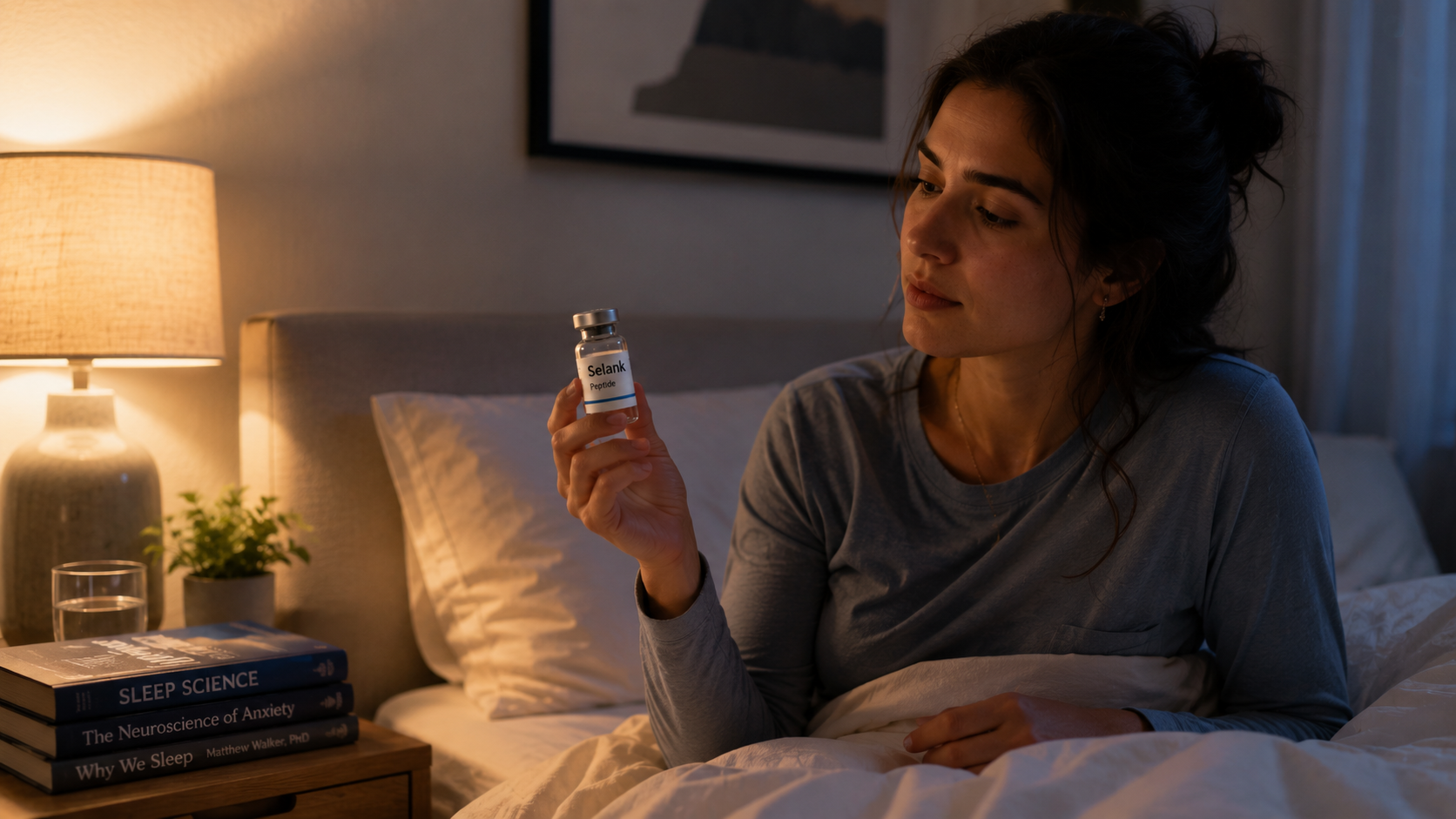
Importantly, Selank is available to U.S. consumers as a dietary supplement, but this does not mean it has been evaluated by the FDA for safety or effectiveness. Unlike prescription drugs, dietary supplements do not require FDA approval before being sold. Some researchers have expressed concern that Selank is being marketed in this way without adequate study. As of April 2026, Selank is classified as an FDA Category 2 bulk drug substance due to safety risk, meaning the FDA has restricted compounding Selank until further review.[10] Further research is needed before conclusions can be drawn about Selank’s role in sleep health.
Conclusion
Selank is a synthetic peptide that was originally developed as a potential treatment for anxiety and stress-related conditions. Research suggests that it acts primarily on GABA receptors, the same systems targeted by benzodiazepines and other anti-anxiety medications. Because anxiety and chronic stress are common contributors to sleep difficulties, researchers have explored whether Selank may indirectly support healthier sleep. Early findings suggest that it may help reduce stress and promote a calmer emotional state, but its effects on the GABA system also mean it shares some characteristics with sedative-hypnotic drugs, and its long-term safety profile has not been well established. While the science surrounding Selank is intriguing, it has not been approved by the FDA for any indication, and its role in sleep medicine has yet to be clearly established. Individuals considering Selank should consult a healthcare provider, particularly given the limited safety data and its drug-like mechanism of action.


.png)
.png)