Reviewed by Sahil Chopra, MD.
Research by Savit Malhotra and Quynh Theresa Do.
Introduction
When you use a Continuous Positive Airway Pressure (CPAP) machine for your sleep apnea, you are likely accustomed to looking at a single number each morning. This number is the apnea-hypopnea index (AHI), which measures how many times your breathing stops or becomes shallow per hour. AHI tends to be used by patients and doctors to determine if PAP therapy is working due to its convenience. However, what if this number isn’t giving you the full story? Our new study, published in the medical journal SLEEP, suggests that relying on this single number might give you a false sense of security. To prove this, we looked at nearly 25,000 nights' worth of data from 465 patients. The results? If we determined CPAP success solely based on CPAP-derived AHI, many patients would be left with residual, untreated apnea. In this blog, we will break down the findings of our publication and what they mean in a clinical setting.
What We Did
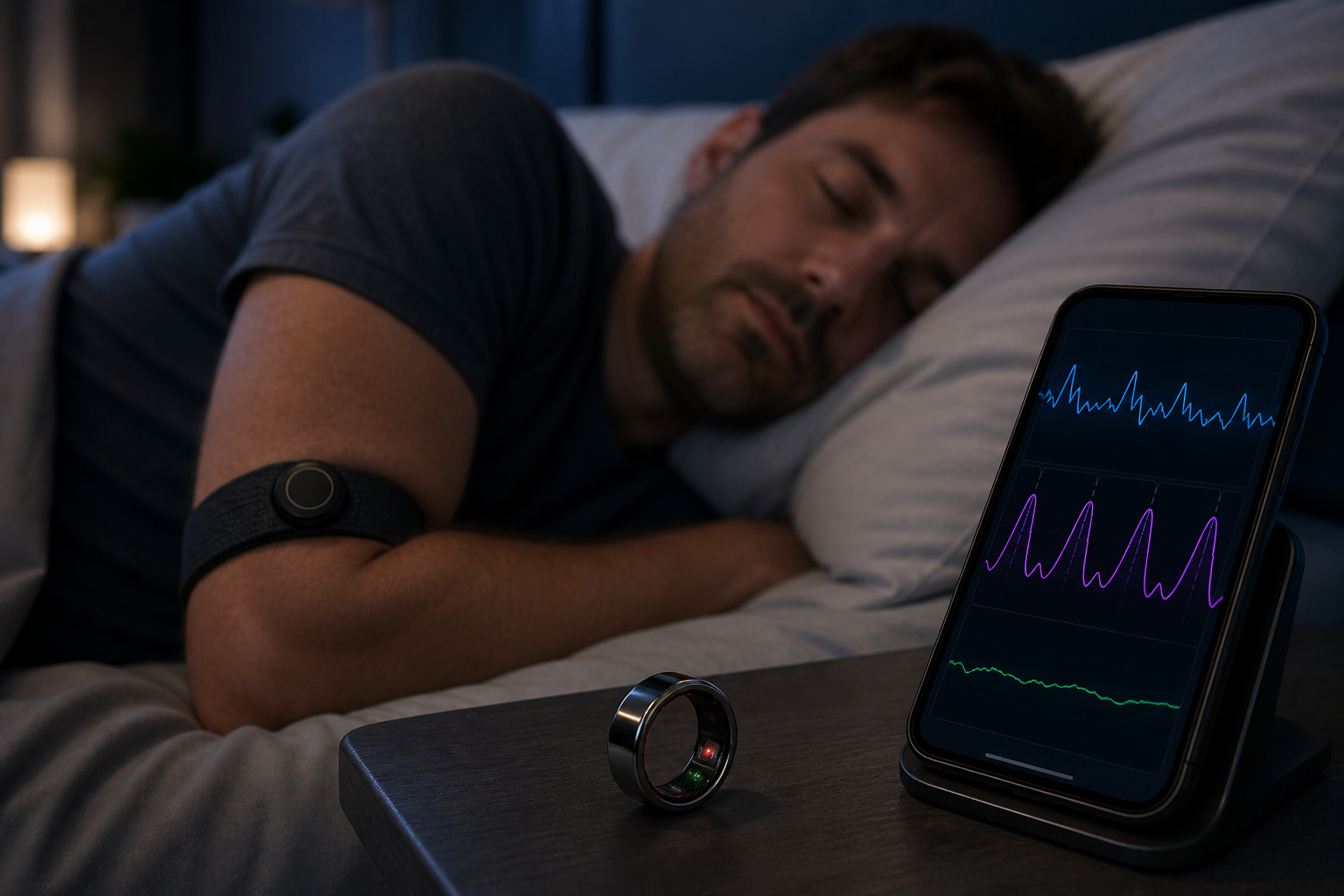
In this study, our team examined whether CPAP machine downloads fully capture how well sleep apnea is being treated. Our research team analyzed 24,939 nights of matched data from 465 patients, comparing the residual AHI reported by standard CPAP devices with measurements from longitudinal cardiopulmonary coupling (CPC) and oximetry monitoring. To elaborate, cardiopulmonary coupling is an analytical technique that measures how your heart rate and breathing interact to generate a detailed sleep spectrogram. This technique can be implemented in wearable devices, such as the SleepImage ring. Because CPC measures physiological signals, it is able to derive an AHI value that differs from the value derived from a CPAP machine. CPAP machines are limited in that their AHI value is based on flow metrics, with no physiological measurements being taken.
More specifically, we collected two types of CPC AHI values, AHI3% and AHI4%, which have different criteria for scoring an apneic event. AHI3% is more sensitive and correlates with a 3% drop in oxygen saturation or an arousal, whereas AHI4% is more strict and requires a drop of at least 4% along with an airflow drop of 30%. We also collected ODI3% and ODI4%, which capture any blood oxygen level drop (of either 3% or 4%, respectively). Finally, we collected oximetry metrics (such as time spent below 90% and 88% oxygen saturation). After collecting these numbers, we ran a series of descriptive statistics to determine the results.

What We Found
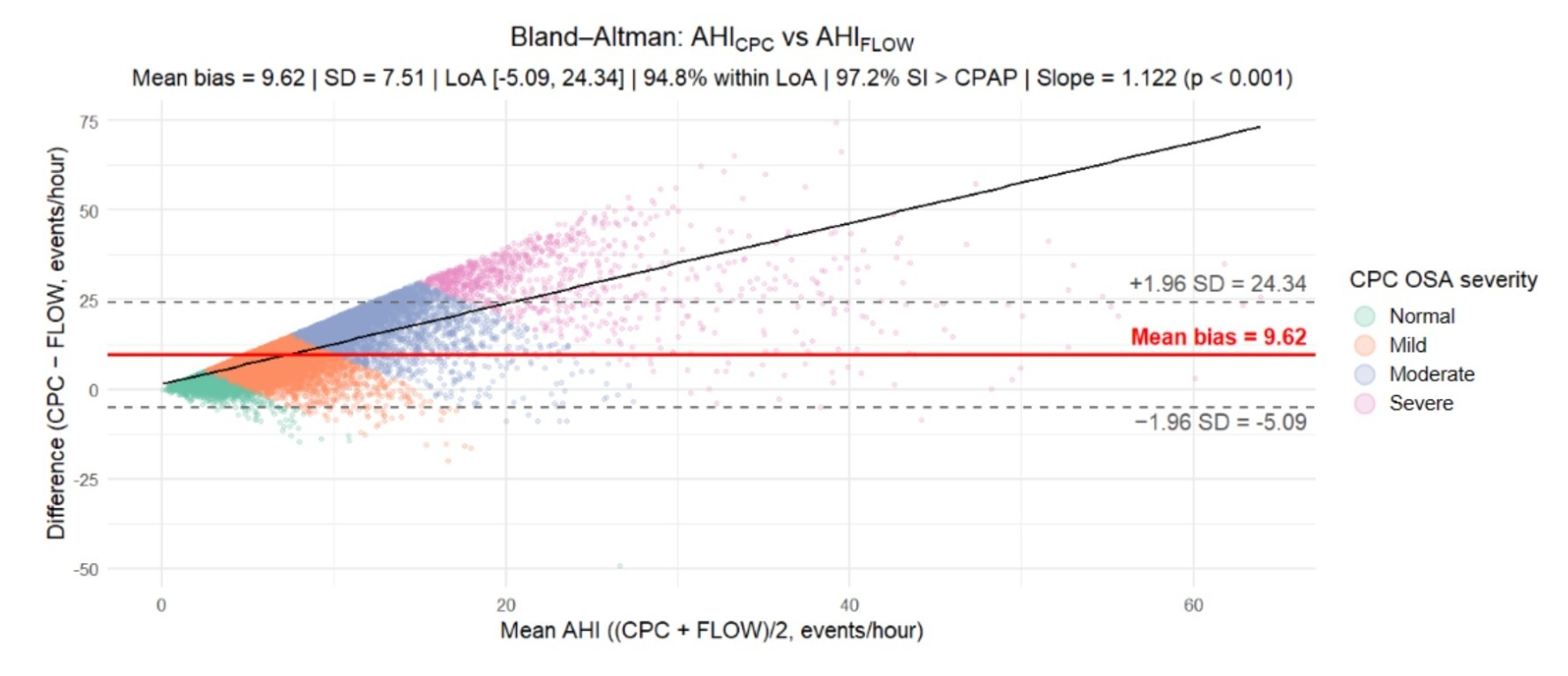
We first took an average (also known as a mean) for our variables of interest for all 24,939 recorded nights. Mean AHI measured by CPAP machine (notated as AHIFLOW) 2.4 events per hour, while the mean AHI measured by CPC device (notated as AHICPC) was 12.1 events per hour for AHI3% and 6.9 events per hour for AHI4%. Mean ODI3% was 8.8 events per hour, and mean ODI4% was 4.1 events per hour. From this first set of analyses, we saw that there was a difference between the means of these values when looking at a night-level.
We then utilized cutoffs defined by the American Academy of Sleep Medicine (AASM)[2] to classify the residual apnea severity of each night. “Normal/At Goal” is defined as AHI equal or less than 5 events per hour, “Mild” as AHI between 5 and 15 events per hour, “Moderate” as AHI between 15 and 30 events per hour, and “Severe” as AHI equal or above 30 events per hour). To summarize, we discovered a significant discrepancy between CPAP and CPC. CPAP devices labeled 89.6% of nights as having a normal residual AHI, yet a deeper look using cardiopulmonary coupling revealed that 85% of these "well-controlled" nights actually had an AHI over 5 events per hour, with nearly half (47.7%) reaching 10 or more. This systematic underestimation was consistent, averaging a difference of 9.66 events per hour in these "normal" nights and increasing drastically with disease severity, reaching a mean difference of 30.55 events per hour in severe cases. Even when we utilized stricter oxygen desaturation thresholds, the trend persisted. We found that a substantial physiologic burden remained hidden in nights that appeared perfectly fine on a standard CPAP download. Specifically, 7.3% of nights labeled as normal still demonstrated an ODI4% of over 10 events per hour. Furthermore, 28.3% had 5 minutes or more with peripheral oxygen saturation (SpO2) less than 90%, and 10.6% had 5 minutes or more with SpO2 less than 88%. These findings confirm that relying on CPAP flow metrics alone may leave much of the residual disease burden undetected.

Should We Trust CPAP Machines Less?
In short, this study is not to say that we shouldn’t trust CPAP download reports, but rather, that we should only see them as one piece of the puzzle. CPAP machines provide extremely valuable data when it comes to assessing adherence and leak, which can help determine treatment performance. However, the information from CPAPs alone is not enough for determining treatment success. Residual AHI should be viewed as one piece of a broader clinical picture. If CPAP AHI is elevated, that information is meaningful and would prompt further investigation to see what the problem is that needs to be addressed. However, this is not to say that the opposite is also true. A normal CPAP AHI doesn’t automatically mean that apnea is well controlled. What this shows is that a normal CPAP download report may be reassuring, but it should not be used to finalize care. Instead, it is important to evaluate the patient as a whole. If a patient is repeatedly saying that they do not feel rested upon waking, then that would be a reason to conduct follow-up testing. Additionally, patients with excessive daytime sleepiness, unrefreshing sleep, morning headaches, or cognitive symptoms despite an apparently good CPAP download report would likely benefit from a closer look.
As we found in our study, patients with certain comorbidities also deserve a closer look. Patients with obesity, COPD, hypertension, stroke, and other cardiopulmonary diseases all had increased odds of having residual hypoxemia. In particular, patients with COPD had the strongest association with residual hypoxemia. It is important to note, however, that our sample size for patients with COPD was only 5 patients. Thus, a definitive conclusion should not be reached, and further research should be conducted to determine if these findings hold with larger populations.
Key Takeaways and What’s Next
Dr. Sahil Chopra, Empower Sleep’s Chief Medical Officer, writes: “The foundation of sleep medicine isn't the device — it's the longitudinal data and sleep health underneath it.” If you have ever wondered whether your therapy is working for you, or if you feel that your sleep isn’t translating into feeling refreshed the next day, it may be time to take a look closer into what the trends are trying to say. Oftentimes, patients will ask what the next step should be. It is important to remember that sleep changes with many things; whether it be stress from the day, medications, insufficient sleep, insomnia, depression, restless leg syndrome, or another sleep disorder, all of these factors should be considered before deciding that a CPAP machine isn’t working. Once we have addressed these possibilities and any others that may be relevant, and there is concern for ongoing residual sleep-disordered breathing, follow-up testing is a strong starting point. Typically, devices like SleepImage can give us insights into residual disease that may go unnoticed by a CPAP algorithm. This can allow us to identify persistent nocturnal hypoxemia, which can then be treated (such as by adjusting pressure settings, switching masks, etc.). We welcome you to reach out to our team at Empower Sleep to discuss your data and explore how further treatment optimization can be implemented.
Among the sleep community, there has been debate regarding the accuracy of CPAP measurements, especially when it comes to metrics like AHI. Our study strengthens the idea that residual disease exists more often than we may think, and that CPAP machines should not be used to finalize care. Instead, we should begin to shift our mindset to acknowledge that CPAP success should be determined by more than just one metric alone. Sleep apnea is a complex condition, and should be treated as such. Complementary measures, such as oxygenation, are one way in which we can move toward a more personalized approach to long-term management. But before beginning complementary measures, the next step could be as simple as asking a patient, “How do you feel?”
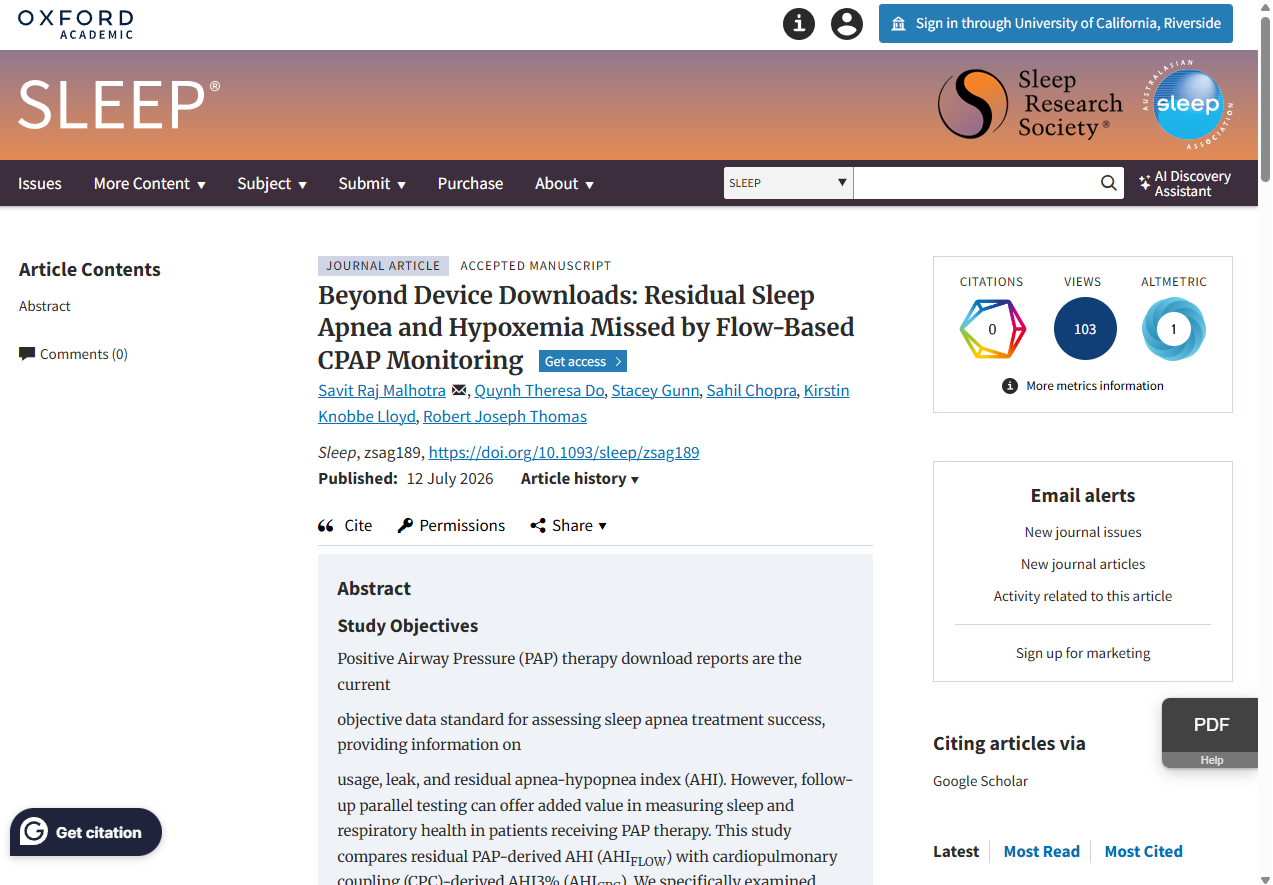
For those interested in the full scientific findings, you can read our newly published piece in SLEEP here.
Citation:
Savit Raj Malhotra, Quynh Theresa Do, Stacey Gunn, Sahil Chopra, Kirstin Knobbe Lloyd, Robert Joseph Thomas, Beyond Device Downloads: Residual Sleep Apnea and Hypoxemia Missed by Flow-Based CPAP Monitoring, Sleep, 2026;, zsag189, https://doi.org/10.1093/sleep/zsag189


.png)
.png)